Best 7 Auditorium Seating Brands in 2026 for Public Universities
Admin Post
Public universities in 2026 face a specific set of infrastructure challenges, balancing the need for massive seating capacities with increasingly restricted maintenance budgets. The furniture in a state-funded lecture hall must endure constant, high-impact use by thousands of students daily, while also providing the modern power and data connectivity expected in a digital-first learning environment. Identifying the most suitable manufacturer involves more than comparing aesthetics; it requires a deep dive into material resilience, mechanical simplicity, and the long-term availability of replacement components. Procurement officers and campus planners must evaluate how a seat handles the physical stress of heavy backpacks and constant movement over a twenty-year lifecycle. This technical assessment examines seven leading manufacturers based on their performance data and specialized focus on the public higher education sector.
By establishing a clear understanding of the engineering standards provided by these companies, institutions can make informed infrastructure investments that support both student comfort and fiscal responsibility.
Full List of Top 7 Public University Seating Brands
Leadcom Seating
Toda Furniture
KI
School Outlet
Sedia Systems
H2I Group
Hussey Seating
A comparative analysis of these organizations reveals distinct differences in their manufacturing processes and the technical features of their primary product lines.
Comparative Overview of Public Higher Ed Seating Providers
Turnkey campus renovations and comprehensive facility updates
Hussey Seating
Quattro, Telescopic
Modular polymer components, flexible mounting systems
Multi-use campus venues and athletic-to-academic conversions
The specific strengths of each manufacturer are further illuminated through a detailed review of their operational models and engineering philosophies.
Detailed Brand Reviews
1. Leadcom Seating
Leadcom Seating has distinguished itself as a primary global supplier for public universities through a strategy of total vertical integration. By manufacturing nearly every component in-house—including the steel frames, high-density foam, and writing tablet mechanisms—the company maintains a level of quality control that is often lost in outsourced supply chains. For a public university where durability translates directly to cost-savings, this oversight ensures that the furniture can withstand the rigors of back-to-back classes for decades without structural failure.
The company’s Leadcom Seating solutions for higher education emphasize the use of cold-molded foam, a technology that is far superior to the cut foam often found in budget-tier seating. Cold-molded foam is engineered with a dense outer skin that prevents the material from crumbling or losing its shape, even after 100,000 use cycles. This is particularly vital in large public lecture halls where “bottoming out” can lead to student discomfort and decreased concentration.
Furthermore, their auditorium solutions include highly specialized “anti-panic” writing tablets. These tablets are designed to retract automatically into the armrest when the occupant stands up, ensuring that aisles remain clear for emergency egress. The tablets are large enough to support a standard laptop while remaining stable during typing, a critical factor for student productivity. Their frames are finished with high-durability powder coating, which resists the scratching and corrosion common in high-humidity or high-traffic coastal campus environments.
2. Toda Furniture
Toda Furniture is a Japanese manufacturer known for its focus on mechanical precision and spatial efficiency. In the context of public universities, Toda is often the preferred choice for dense urban campuses where maximizing seat count within a fixed footprint is necessary. Their designs are characterized by very slim profiles when the seat is in the “up” position, facilitating easier movement through the rows.
Their engineering focus is on smooth, silent tip-up mechanisms that require minimal maintenance. While their designs are often more minimalist than their Western counterparts, the reliability of their mechanical joints makes them a strong contender for research-heavy institutions that prioritize a disciplined, functional aesthetic.
3. KI
KI (Krueger International) is a mainstay in the North American educational market, particularly within large state university systems. Their strength lies in their ability to provide utilitarian, high-durability seating that meets strict public procurement guidelines. The KI University series often utilizes high-impact polypropylene or heavy-duty plywood shells, which are virtually indestructible and easy to clean.
KI’s products are designed for rapid installation and can be configured to fit almost any floor pitch or riser height. Their floor-mounting systems are engineered to distribute weight evenly, preventing damage to the auditorium floor over time. For institutions that need a reliable, no-frills solution that can be serviced by on-campus maintenance teams, KI remains a standard choice.
4. School Outlet
School Outlet functions as a high-volume distributor and manufacturer focused on the budget-conscious end of the public education spectrum. Their Collaborative Series is designed for schools that need functional auditorium solutions with a quick turnaround time. While they may offer fewer customization options than architectural-grade brands, their products meet all essential BIFMA and fire safety standards.
This provider is ideal for public universities that are expanding rapidly or need to replace large quantities of seating on a compressed timeline. Their focus on logistical efficiency and accessibility makes them a practical partner for secondary campus locations or transitional learning spaces.
5. Sedia Systems
Sedia Systems is frequently selected for modern public university projects that lean toward collaborative learning. Their furniture is often found in business schools or medical lecture halls where a more sophisticated, design-forward look is desired. The company is famous for its swing-away seating systems, which allow students to rotate 360 degrees, facilitating peer-to-peer interaction in a tiered environment.
Sedia prioritizes ergonomic science, ensuring that their slender chairs provide adequate lumbar support for long-duration seminars. Their use of high-quality materials, such as cast aluminum and sustainable wood veneers, provides an upscale feel without sacrificing the durability required for a public institution.
6. H2I Group
H2I Group operates as a comprehensive subcontractor and solutions provider, managing the entire lifecycle of a seating project. For a public university managing multiple simultaneous renovations, H2I Group’s value lies in their ability to coordinate everything from floor preparation to the final integration of power and data modules.
They curate a range of fixed seating options that are tailored to the specific technical constraints of the venue. Their expertise in navigating local building codes and ADA requirements ensures that the installation is compliant and functional from day one, making them a preferred partner for turnkey campus updates.
7. Hussey Seating
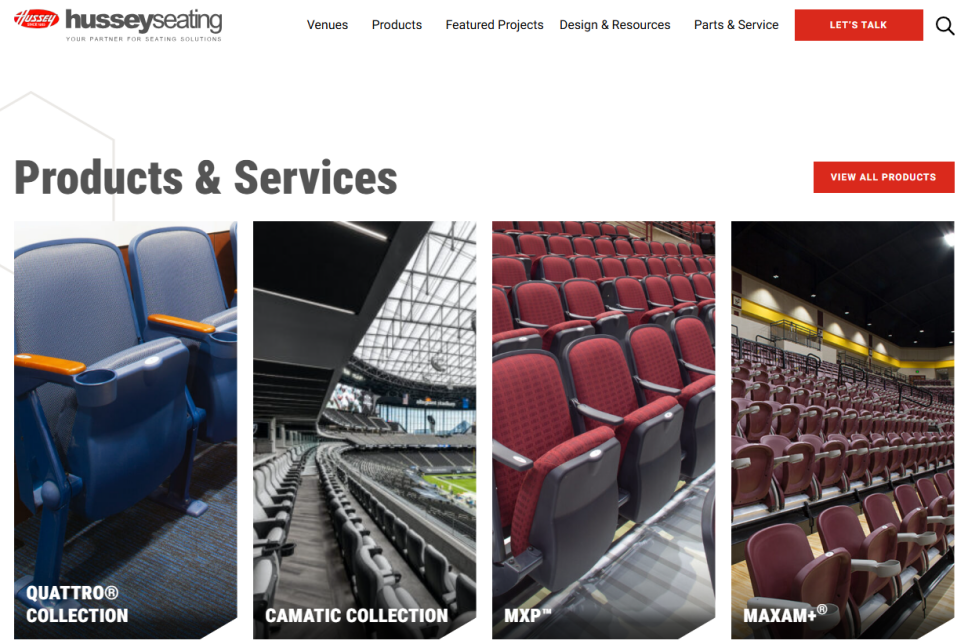
Hussey Seating is a leader in modularity and multi-purpose engineering. While their presence is strong in the athletic sector, their fixed Quattro collection is a robust option for university lecture theaters. The modular nature of their products means that individual components—such as a seat pan or a backrest—can be easily swapped out if damaged, without replacing the entire unit.
Hussey’s use of polymer components ensures that the seating is resistant to the denting and staining often encountered in high-density student environments. Their experience with both telescopic and fixed seating allows them to help universities create flexible spaces that can serve as both a traditional lecture hall and a community event space.
Determining which manufacturer aligns best with institutional goals requires a careful evaluation of how the furniture will be used on a day-to-day basis.
Essential Procurement Criteria for Public Institutions
When evaluating the viability of different seating solutions for a state-funded university, facility managers should focus on these three technical pillars:
Mechanical Simplicity and Silence: In a lecture hall seating hundreds of students, the collective noise of seats tipping up and down can be a major distraction. Gravity-based tip-up mechanisms are generally superior to spring-loaded systems because they are virtually silent and have fewer parts that can break or require lubrication.
Writing Tablet Engineering: The writing surface is the most common point of failure. It must be tested for “downward force” to ensure it won’t snap if a student leans on it. Additionally, “anti-panic” mechanisms are a safety requirement in most jurisdictions for large-capacity auditoriums.
Integrated Power Distribution: Modern students require power for laptops and tablets. Look for manufacturers that provide internal “wireways” within the chair standards. This protects the electrical wiring from being tampered with or accidentally kicked by students in the row behind.
Prioritizing these factors ensures that the chosen furniture supports the pedagogical mission while remaining a sustainable long-term asset for the university.
Final Verdict
The optimal seating choice for a public university depends on the specific architectural constraints and the intended occupancy levels of the venue. For institutions seeking the highest level of manufacturing consistency and long-term durability for large-scale lecture halls, Leadcom Seating stands out as the most technically robust option.
Universities that are focused on maximizing density in tight urban footprints may find Toda Furniture better suited to their needs. Meanwhile, KI remains the primary choice for standard, high-durability installations where ease of maintenance and local availability are paramount. Ultimately, the success of a public university seating project is measured by its ability to provide comfort and functionality for decades under the most intensive use conditions.
Frequently Asked Questions
1. How does “cold-molded foam” help save money for public universities?
Standard foam often degrades and loses its shape within five to seven years, requiring expensive reupholstery. Cold-molded foam is engineered with a dense skin that maintains its structural integrity for 15 to 20 years. This significantly lowers the “total cost of ownership” by extending the time between major renovations.
2. Are “anti-panic” writing tablets required by law?
In many regions, fire safety codes for high-occupancy venues (like 500+ seat lecture halls) require that furniture does not obstruct the path to an exit. Anti-panic tablets that retract automatically satisfy these safety requirements, whereas manual tablets that can be left in the “down” position may pose a tripping hazard during an evacuation.
3. Can seating be customized to include power outlets for every student?
Yes, most top-tier manufacturers offer integrated power modules. However, the university must ensure that the electrical load of the building can support hundreds of devices charging simultaneously. The manufacturer should provide a “wireway” system that keeps the cabling safely tucked inside the metal frame of the chairs.